
AI narration · about 10 min
Flock license plate readers are appearing across Florida. Supporters call them a powerful public safety tool. Critics worry they could become something much bigger.
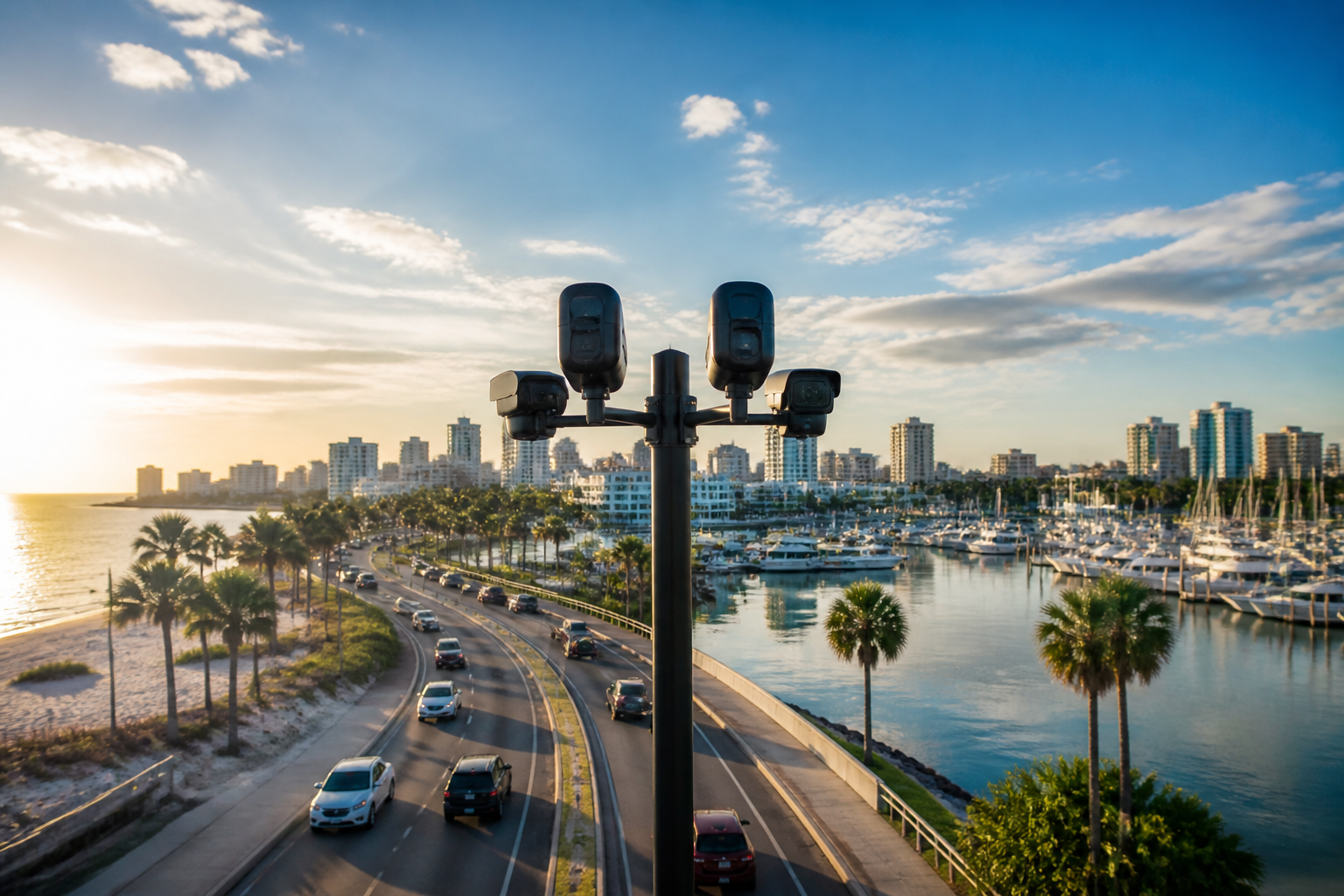
The first thing you notice is the pole. It stands quietly along the side of the road, easy to miss among traffic lights, utility lines and the general visual clutter of Florida streets. At the top is a camera pointed toward passing traffic. It isn't a red-light camera, and it isn't necessarily a speed camera. Depending on where you live, it may not be something you ever remember seeing before. It is a Flock camera.
Across Florida, automated license plate readers have become an increasingly familiar part of the landscape. The technology is designed to capture information about vehicles passing through specific locations, including license plates, vehicle characteristics, time and location. The pitch is simple: help law enforcement find stolen cars, identify vehicles connected to crimes and solve cases faster. But as the cameras spread, so does the debate. Because the cameras don't only capture criminals. They capture everyone.
A Tool for Public Safety — or a New Kind of Surveillance?
Imagine a stolen car. Police know the make, model and license plate. Somewhere across town, that vehicle passes one of these cameras and an alert is generated. Investigators now have a lead. That is the version of the story most people can get behind.
The same technology could potentially help connect a vehicle to a hit-and-run, burglary or other serious crime. For law enforcement, that can mean valuable information at a moment when time matters. But there is another version of the story. You drive to work, stop for coffee, visit a friend, go to dinner or head to the beach. At various points along the way, your vehicle may pass cameras that record its presence. You may never be suspected of a crime. You may never be contacted by police. You may never know your vehicle was captured at all. But the information exists.
And that is where the conversation becomes much more complicated.
The debate surrounding Flock cameras is not necessarily about whether the technology can be useful. It clearly can be. The bigger question is what happens when a tool designed to find specific vehicles becomes part of a much larger network of searchable data. How long is that information kept? Who can search it? Under what circumstances? Can the data be shared with other law enforcement agencies? Can a vehicle's movements be pieced together over time? And what kind of oversight exists to make sure the system is used for its intended purpose?
Those questions are becoming increasingly important as automated license plate readers become more common across Florida. One camera may tell you that a car was in one place. A network of cameras may begin to tell you where that car has been.
The ‘Bar Zone’ Question
One of the more controversial discussions surrounding the technology involves how automated license plate data could potentially be used around bars, restaurants and entertainment districts. Consider a hypothetical scenario: a vehicle is recorded near a popular nightlife area. Later, the same vehicle is observed driving erratically or is pulled over for a traffic violation. Could the fact that the vehicle was previously near a bar become part of the broader investigation?
The idea immediately raises questions. Being near a bar does not mean someone is drunk. A person may be picking up a friend, working at the business, having dinner, waiting for someone or driving through the area entirely by coincidence. The camera knows where the vehicle was. It does not know what happened inside the vehicle, whether the driver had a drink or whether the driver is impaired.
That distinction matters. DUI enforcement is an important public safety issue. Drunk driving kills people, and law enforcement agencies across Pinellas County and Florida conduct enforcement operations designed to identify impaired drivers. But the broader concern is how data collected for one purpose might eventually be used to draw conclusions about people who have done nothing wrong.
The camera captures facts. People interpret those facts. And those interpretations are where the controversy begins.
The Privacy Debate Is Bigger Than a License Plate
For many critics, the concern is not simply that a license plate is being photographed. It is what that photograph can become when combined with other information.
A single image of a vehicle is one thing. A series of images over days, weeks or months can create a pattern. A pattern can reveal routines — where someone works, where they spend their evenings, which neighborhoods they visit and how often they travel. The person behind the wheel may not even be the vehicle's owner, and yet the data can still become part of a record associated with that vehicle.
Supporters of Flock cameras argue that the system is not the same as having an officer physically follow someone or tracking a person's cellphone in real time. That distinction is important. But critics argue that the ability to search historical location data can still create a powerful picture of someone's movements.
The technology may not be following you. But it may remember where you went.
The Argument for the Cameras Is Strong
It would be easy to turn the Flock camera debate into a simple story about privacy versus police. The reality is more complicated.
A family whose car was stolen may not care about the philosophical debate surrounding automated license plate readers. They want their car back. A person involved in a hit-and-run may be identified because a camera captured the vehicle. A suspect connected to a serious crime may be located because investigators were able to find a vehicle's movements. Those are real benefits.
For law enforcement, technology that can help solve crimes without requiring officers to manually review hours of video can be an important tool. The concern is not that the technology has no value. The concern is what happens when the technology becomes so widespread that the public no longer knows exactly how it is being used.
The Rules Matter
The most important part of this conversation may not be the cameras themselves. It may be the policies surrounding them.
What are the limits? How long is data stored? Who is allowed to search it? What justification is required? Are searches audited? What happens if someone misuses the system? Can data be shared outside the agency that collected it?
These may sound like boring policy questions, but they are not. They are the difference between a narrowly focused investigative tool and a system that can potentially become something much larger.
Technology tends to move quickly. Rules often move much more slowly. And history has shown that once information is collected, it can be difficult to put the genie back in the bottle.
The Future of Florida's Roads
The cameras are already here. The question now is what role they will play in the future.
Will they remain primarily a tool for locating stolen vehicles and investigating serious crimes? Will their use expand? Will more agencies gain access to the information? Will residents have more control over how the technology operates? Or will the cameras simply become another piece of infrastructure that people stop noticing?
That may be the most important question of all.
Because the controversy surrounding Flock cameras is not really about one camera on one road. It is about the relationship between technology, privacy and public safety.
Most people want safer communities. Most people want dangerous drivers off the road. Most people want stolen cars recovered and serious crimes solved. But people also have a reasonable right to ask what information is being collected about them — and what happens to it once it exists.
The camera on the pole doesn't know whether you are a criminal. It doesn't know whether you are coming home from work. It doesn't know whether you just left a bar, picked up a friend or simply took a wrong turn.
It only knows that your vehicle was there.
The real question is what happens next.
Comments
Want to join the conversation?
Sign in to comment